1.When an advance receipt is issued
The Law on Fiscalization explicitly says that fiscalization covers not only retail sales but also advances received for future sales. The receipt is issued when the advance is received — not later, when the goods are delivered.
In practice an advance receipt is most often issued when:
- a customer pays an annual or monthly subscription in advance;
- a customer buys a voucher, gift card or service package used later;
- a customer pays for a course, event or booking before it starts;
- a customer pays part of the amount upfront and the rest on delivery.
Whether a payment is an advance or an immediate sale depends on when delivery happens. If unsure about your case, confirm with your accountant.
2.What goes on an advance receipt
An advance receipt lists no products but a single item named “Аванс” (advance), quantity 1, for the amount received. In front of the word is a number and after it the tax label in brackets, both depending on the tax rate the future sale will be taxed at, as set out in the Tax Administration guide on advance payments:
| Label | Rate | Item name |
|---|---|---|
| Ђ | VAT 20% (general rate) | 10: Аванс (Ђ) |
| Е | VAT 10% (special rate) | 11: Аванс (Е) |
| Г | VAT-exempt sale, 0% | 12: Аванс (Г) |
| А | outside the VAT system, 0% | 13: Аванс (А) |
Flat-rate taxpayers and anyone outside the VAT system send “13: Аванс (А)” — not “10: Аванс (Ђ)”, which would report 20% VAT that was never charged.
At the customer’s request, the products covered by the advance may be listed in the advertising section. If the customer pays in instalments, each payment is its own advance receipt, and each one references the previous.
3.How an advance is closed: three receipts
An advance stays “open” until you close it. On delivery you do not issue just one final receipt — the advance is refunded first, and only then is the final receipt with the actual products issued. The chain always runs in this order:
- 1Advance — SaleWhen the customer pays upfront. One “Аванс” item for the advance amount. This receipt goes to the customer.
- 2Advance — RefundOn delivery, before the final receipt. It references the last advance sale receipt. This receipt is not given to the customer.
- 3Normal — SaleRight after the refund. The final receipt with the actual products, referencing the advance refund. This receipt goes to the customer.
Choose the tax label and click a step to see exactly what goes on each receipt:
Choose the tax label
One item, quantity 1, the advance amount. Each further advance for the same purchase references the previous one.
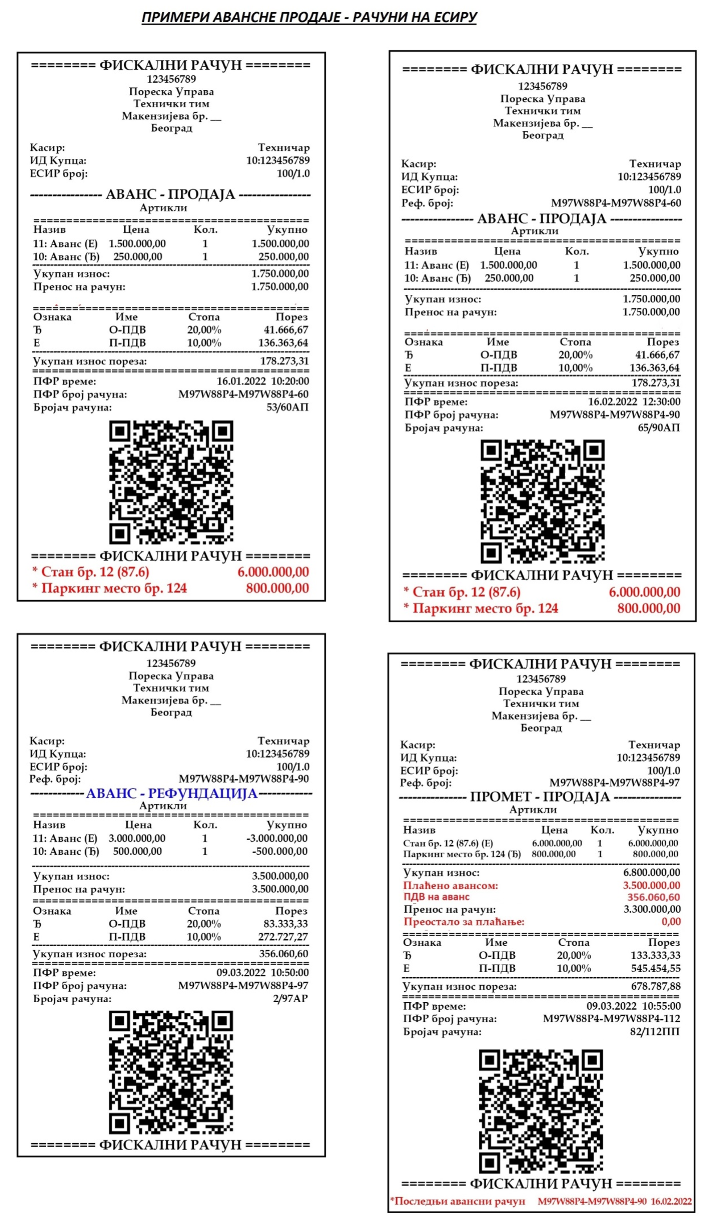
This is what the whole chain looks like on real receipts, in the Tax Administration example with two advances: two Advance — Sale receipts, then an Advance — Refund for the total advance, then the final Normal — Sale. Below the closing line of the final receipt stand the number and date of the last advance receipt.
4.Which receipt references which
The receipts in the chain are linked by references: each one carries the number and time of the previous receipt. The same order ID on all three does not link them — only the reference does.
- The first advance has no reference. Each further advance for the same purchase references the previous advance.
- The advance refund references the last advance sale receipt.
- The final receipt references the advance refund.
The advertising section of the final receipt must show the number and date of the last advance sale receipt — not the refund. This is the most common mistake in the chain.
5.An end-to-end example
You sell an online course for 12,000 RSD with 20% VAT. The customer pays on 1 March, and the course starts on 15 March. These are the three receipts you issue:
АВАНС ПРОДАЈА
10: Аванс (Ђ)          1 × 12.000,00
Укупан износ                12.000,00
ПФР број: …-…-101
АВАНС РЕФУНДАЦИЈА
10: Аванс (Ђ)          1 × 12.000,00
Референца: …-…-101
(not given to the customer)
ПРОМЕТ ПРОДАЈА
Online course (Ђ)      1 × 12.000,00
Референца: (advance refund number)
Аванс: …-…-101 од 01.03.
The customer thus gets two receipts — the advance on 1 March and the final one on 15 March — while the refund stays in your records.
6.Special cases
Choose a situation to see which receipts are issued:
Choose — the list of receipts appears here.
7.Advances through FiskalAPI
The whole chain is three API calls, and it also works on the free test key, with no tax consequences:
| Receipt | Call | What is sent |
|---|---|---|
| Advance — Sale | POST /api/racuni/avans | item “10: Аванс” with the tax label sent separately — the V-PFR prints “(Ђ)” itself |
| Advance — Refund | POST /api/racuni/avans/refundacija | number and time of the last advance |
| Normal — Sale | POST /api/racuni | the actual products and the refund number |
Frequently asked questions
Yes. The Law on Fiscalization explicitly includes advances received for future retail sales in fiscalization, and the receipt is issued when the advance is received.
A single “Аванс” item with the rate number in front, quantity 1 and the advance amount: “10: Аванс (Ђ)” for 20% VAT, “11: Аванс (Е)” for 10% VAT, “12: Аванс (Г)” for VAT-exempt sales and “13: Аванс (А)” for taxpayers outside VAT. Products may be listed in the advertising section at the customer’s request.
With an advance refund referencing the last advance receipt, immediately followed by a final sale receipt referencing that refund. The refund is not given to the customer.
The number and time of the advance refund. And the advertising section of the final receipt must show the number and date of the last advance sale receipt.
A flat-rate taxpayer, i.e. one outside the VAT system, sends the item “13: Аванс (А)” — an advance for taxpayers outside the VAT system, 0%.
The Tax Administration guide does not cover this case. In practice, when the money is returned, an advance refund referencing the last advance is issued, and no final receipt is issued because no sale took place. Confirm with your accountant before doing so.
Sources: Law on Fiscalization (Arts. 3, 4 and 6) and the Tax Administration guide “Issuing fiscal receipts when advances are collected in the e-fiscalization system” (help on tap.suf.purs.gov.rs). Confirm your case with an accountant.