E-FISCALIZATION IN SERBIA
Serbian e-fiscalization,
explained on a single receipt.
Since May 2022, every retail sale in Serbia goes through the Tax Administration’s e-fiscalization system: an approved software issues the receipt, a security element signs it, and the Tax Administration receives it at the moment of sale. Here is the whole journey of one receipt, step by step, based on the text of the Law on Fiscalization.
- Based on the Law on Fiscalization, as amended in 2026
- Approved ESIR · ID 1609
JOURNEY OF ONE RECEIPT — CLICK A STEP
1/5 · Electronic invoicing system
ESIR
The software or device where the sale is entered and the fiscal receipt is issued from. Its use must be approved by the Tax Administration. With FiskalAPI the ESIR is an API: your shop or program sends the items in one call.
Supplied by a software vendor — e.g. FiskalAPI, ID 1609
Do you have to issue fiscal receipts?
Retail sales and advances received for retail sales are fiscalized. Every sole proprietor — including flat-rate ones — and every legal entity making retail sales is subject to it, regardless of how the buyer pays: cash, card or bank transfer. Whether your sale counts as retail depends on who you sell to and where:
Who do you sell to?
Where do you sell?
Articles 3 and 4 of the Law on Fiscalization
Answer the questions — the result appears here.
Who is exempt from fiscalization
A Government decree lists the activities that do not have to record sales through a fiscal device. The list is short and precise — often only part of an activity is exempt, so read the right-hand column too:
| Activity | Code | What exactly is exempt |
|---|---|---|
| Passenger transport | 49.31, 49.32, 51.10 | urban and suburban land transport, taxis and air passenger transport |
| Roads and parking | 52.21 | road, bridge and tunnel tolls, and parking paid through third parties or a mobile operator |
| Post and telecoms | 53.10, 61 | public-service postal activities and telecommunications |
| Finance and insurance | 64, 65, 66 | financial services, insurance and activities auxiliary to finance |
| Legal services | 69.10 | lawyers and other legal services — but not notaries and bailiffs |
| Education | 85 | education — except group 85.5 “Other education”: courses, language schools, driving schools and similar are fiscalized |
| Health care | 86 | only services paid from compulsory health insurance — private examinations are fiscalized |
| Veterinary | 75.00 | only field animal health protection, work under the Programme of measures, disinfection and pest control of premises with animals |
| Social care | 84.30, 87, 88 | compulsory social security and social work, residential and non-residential |
| Gambling | 92 | only the State Lottery and games whose organiser reports sales electronically |
| Religious organisations | 94.91 | the whole activity |
| Public utilities | — | except cemeteries and burials, funeral services, public car parks not paid through third parties and renting market stalls |
| Metered bills | — | electricity, gas, water, heating, telephone — when billed by meter reading |
| Traditional and art crafts | — | activities on the list of traditional and art crafts and home industry — except stonemasons |
| Street vending | 47.99, 96.09 | travelling sellers of ice cream, lottery tickets, popcorn and newspapers; shoe shiners and porters |
| Farmer at a market | — | an individual who is not a sole proprietor, selling their own farm produce |
| Marketing services | — | in a retail outlet, when paid by a company or sole proprietor |
| Market stalls | — | temporarily: from 1 May 2022 up to and including 31 December 2026 |
The exemption for market stalls expires on 31 December 2026. The deadline has been extended before, but if it is not extended again, sales at market stalls will need fiscal receipts from 1 January 2027. Check before the end of the year whether the decree has changed.
A business with both an exempt and a non-exempt activity must issue fiscal receipts for the non-exempt one (Article 4(4) of the Law). Example: a school whose regular education is exempt, but whose foreign language courses are not.
Source: Decree on activities without the obligation to record retail sales through an electronic fiscal device (Official Gazette RS nos. 32/2021, 117/2021, 51/2022, 141/2022, 85/2023, 99/2024 and 110/2025), Articles 2–4a.
Getting started: four steps to your first receipt
- 01
Register your business premises
Before the first receipt, you submit data on each business premises to the Tax Administration electronically and receive its unique code. For online sales, the premises is your registered seat. Any change is reported at least 24 hours in advance.
- 02
Security element
Requested on the ePorezi portal, after the premises is registered. To work through a V-PFR, as with FiskalAPI, you choose the element in file form.
- 03
Approved ESIR and PFR
The law explicitly requires you to check, before you start, that the elements you use are approved. The register of approved elements is public, on the Tax Administration website.
- 04
First receipt
The receipt is issued at the moment of sale and reaches the Tax Administration at the same moment. If the internet is down, the data is sent as soon as the connection is back, and within five days at the latest.
With FiskalAPI the third item is covered: the ESIR is ours and listed in the register, and the V-PFR is in the Tax Administration’s system. You register the premises and obtain the element — once.
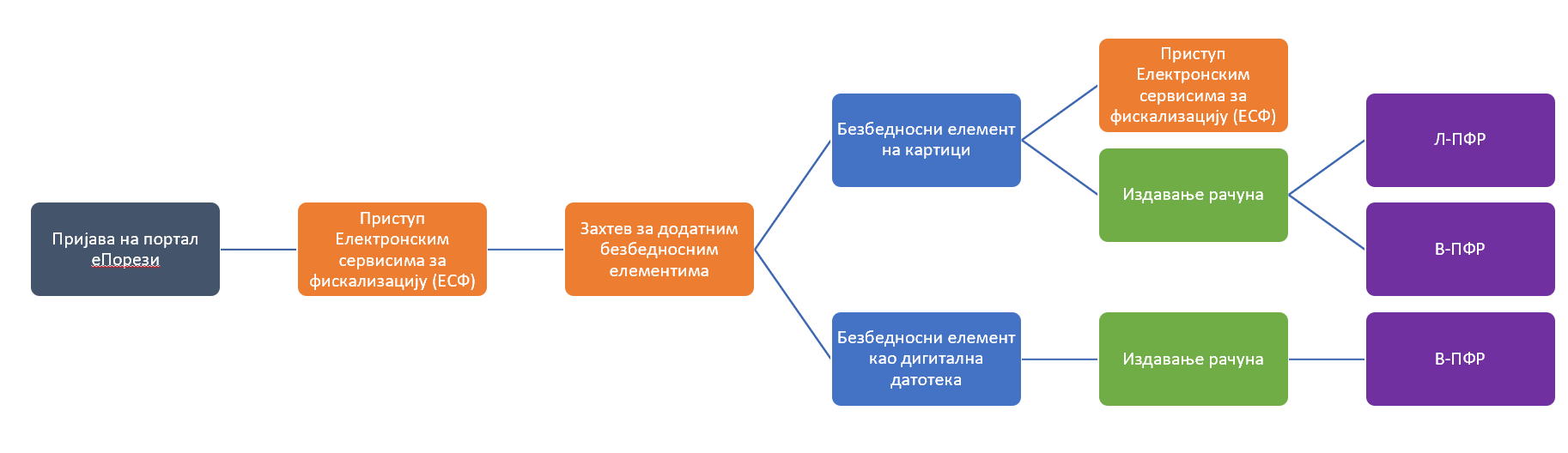
V-PFR or L-PFR — which do you need?
The law lets you choose the processor, with one rule for physical premises. The answer follows Article 6 of the Law on Fiscalization.
Where do you sell?
Article 6(4), Law on Fiscalization
Pick an answer — the result appears here.
What a fiscal receipt must contain
Article 5 of the Law lists the data without which a receipt is not valid. In short:
- receipt type and transaction type — for example ПРОМЕТ ПРОДАЈА (normal sale)
- seller’s name and PIB and the unique code of the business premises
- the buyer’s PIB, when the buyer is a company or sole proprietor
- for each item: name, quantity, unit, price and tax label
- tax rates, tax per rate and total tax
- total amount, payment method, amount paid and change — noting if paid by advance
- date and time, to the second
- the unique receipt number and the counter per receipt and transaction type
- a QR code on a printed receipt, or a verification link on an electronic one
- a reference to another receipt, when needed — for example on a refund
A receipt missing mandatory data, or with wrong data affecting the tax, is fined the same as a receipt not issued.
Full guide: receipt number, verification and cancellation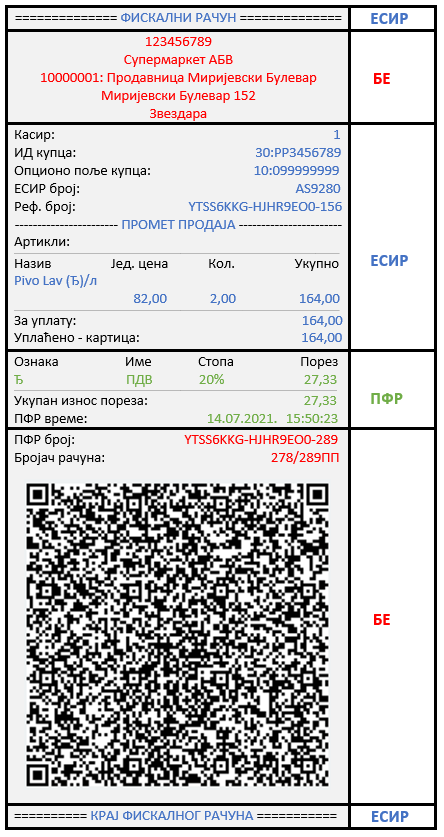
Penalties
The law imposes fines, and for unrecorded sales also a ban on doing business. Amounts are in dinars:
| Offence | Legal entity | Sole proprietor | Responsible person |
|---|---|---|---|
| Sale not recorded, receipt not issued or not fiscalized at the moment of sale, receipt missing mandatory data, or no L-PFR in the premises when required (Art. 15) | 300,000–2,000,000 | 50,000–500,000 | 20,000–150,000 |
| The proper security element is not used, or after an internet outage data is not sent within five days (Art. 16) | 300,000 | 150,000 | 50,000 |
| Premises not registered before the first receipt, or a change not reported in time (Art. 17) | 200,000 | 100,000 | 30,000 |
When an inspector finds that sales were not recorded, besides the fine they ban business in that premises: 15 days the first time, 90 days the second time and one year the third time, if the irregularities repeat within 24 months of the first. For a receipt with a fake QR code the ban is one year and takes effect immediately (Art. 12).
From cash register to e-fiscalization
Jan 2027
Market stall exemption expires
Under the current decree, sales at market stalls are exempt from fiscalization up to and including 31 December 2026. Unless the deadline is extended, market stalls will issue fiscal receipts from 1 January 2027.
Where next
- GuideFiscal receiptA sample receipt, where the number is, verification, refund and fines.
- GuideSecurity elementHow to get it on ePorezi, PIN and PAK, three-year renewal.
- GuideAdvance receiptsAdvance, advance refund and final receipt — the whole chain.
- GuideTax labelsWhat Ђ, Е, Г and А mean, which one flat-rate businesses use and how tax is calculated.
- GuidePayment methodsThe seven methods in the rulebook, cash on delivery, PayPal and split payments.
- GuideSubscriptions and servicesWhich receipt for monthly and annual plans, courses and digital products.
- For shopsOnline fiscal cash registerThe receipt is issued automatically when the customer pays — by card, COD or in advance.
- For shopsOnline shop fiscalizationReady-made modules for WooCommerce, Shopify, Magento, PrestaShop and OpenCart.
- For shopsWooCommerce fiscalizationA free plugin: a receipt with QR code for every order.
E-fiscalization questions
Approved ESIR · ID 1609It is the system in which every retail sale is recorded through an electronic fiscal device and sent to the Tax Administration at the moment of sale. The device has three parts: the ESIR where the sale is entered, the fiscal receipt processor (PFR) that signs and transmits the receipt, and the security element holding the taxpayer’s certificate. The law says this can be a hardware and/or software solution.
The Law on Fiscalization applies from 1 November 2021. The transition period lasted until 30 April 2022, and from 1 May 2022 the Law on Fiscal Cash Registers no longer applies — everyone works under the new model. The law was amended in 2021, 2022 and 2026.
Every sole proprietor — including flat-rate ones — and every legal entity making retail sales: sales of goods and services to individuals, and every sale in a retail outlet. Advances received are recorded too. Only the activities listed in the Government decree are exempt — the list is above on this page.
Under the Government decree, among others: urban transport, taxis and air passenger transport, post and telecoms, banks and insurance, lawyers (but not notaries and bailiffs), regular education (but not courses and driving schools), health care only from compulsory insurance, social care, religious organisations, most public utilities and traditional and art crafts. Market stalls are exempt up to and including 31 December 2026.
In a retail outlet — yes, and the buyer’s PIB is printed on the receipt. A sale to a company or sole proprietor outside a retail outlet is not a retail sale and needs an invoice. The law deems the registered seat of a business selling online a retail outlet.
The ESIR is the software where the sale is entered. The PFR turns that data into a fiscal receipt, signs it and sends it to the Tax Administration. The security element holds your electronic certificate used for signing. The ESIR and PFR must be approved by the Tax Administration, and it issues the security element.
A V-PFR is in the Tax Administration’s system and works online only; an L-PFR is on your device and issues receipts offline too. If you sell exclusively online, a V-PFR alone is enough. If you have physical premises and choose a V-PFR, you must also have at least one L-PFR device in every business premises.
The Tax Administration keeps a public register of approved elements of electronic fiscal devices (ESIR and PFR) on its website, and the law requires the taxpayer to check it before starting to use a device. FiskalAPI is listed as an ESIR under ID number 1609.
The amendment published in Official Gazette RS no. 80/2026 introduced a strict measure against fake receipts: issuing a receipt with a QR code that was not generated in the e-fiscalization system, leads to another receipt or was altered afterwards results in an immediate one-year ban on doing business.
Source: Law on Fiscalization (Official Gazette RS nos. 153/2020, 96/2021, 138/2022 and 80/2026) and the Decree on activities without the obligation to record retail sales through an electronic fiscal device (last amended by no. 110/2025), consolidated texts on the Legal Information System of the Republic of Serbia. For information only; confirm your case with an accountant.
Fiscalize your sales without a device
Request a free test key — we open accounts the same day.